



The Question Nobody Asks First
Most companies jump straight to "which consultancy should we hire?" or "which tool should we buy?" before asking the real question: what's the right model for your situation?
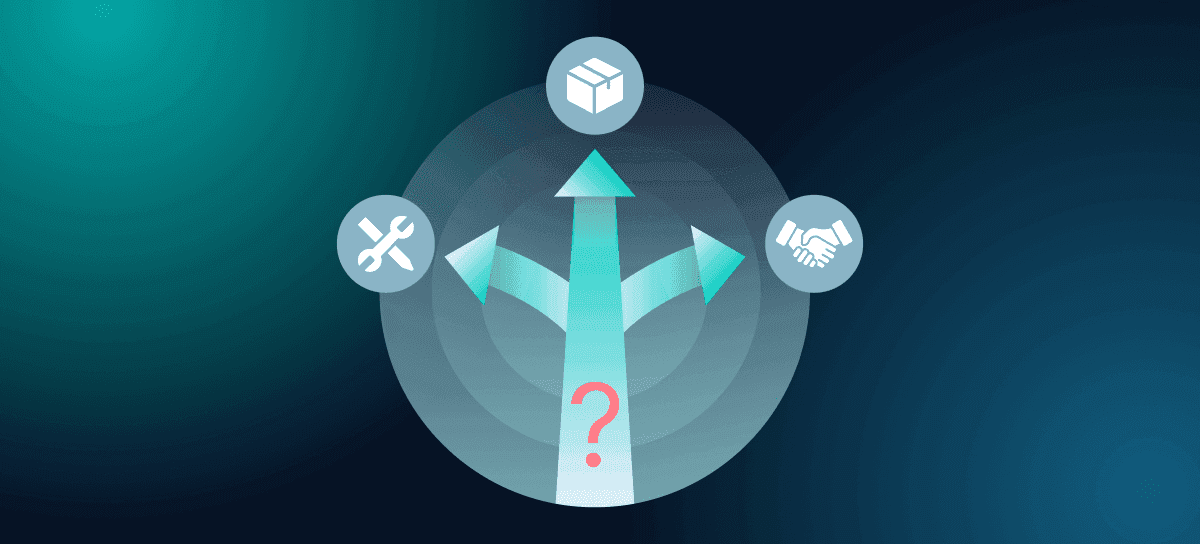
Should you build capability in-house? Buy an off-the-shelf solution? Partner with external specialists?
The answer depends on your timeline, budget, strategic priorities, and—critically—your existing internal capability. Getting this decision wrong costs more than a bad vendor choice. It costs 6-12 months and a failed initiative that poisons the well for future AI investment.
The Three Paths
Build (Hire In-House)
Recruit AI/ML engineers, data scientists, and prompt engineers. Build your own team from scratch or expand an existing technical function.
The upside: full control, institutional knowledge stays internal, and you're making a long-term capability investment that compounds over time. Your team learns your domain, your systems, your quirks.
The downside: hiring is slow, expensive, and competitive. Senior AI talent commands £150-300k+ packages, and even then you're competing with Google, Meta, and well-funded startups. A single hire can't cover strategy, engineering, MLOps, and production support. Expect 6-12 months before a new team is genuinely productive.
Buy (Off-the-Shelf Tools)
SaaS platforms, vertical AI solutions, API integrations. Someone else has built it; you configure and deploy.
The upside: fast deployment, predictable costs, and you're leveraging someone else's R&D investment. For common use cases—customer support chatbots, document processing, standard analytics—buying often makes sense.
The downside: limited customisation, vendor lock-in, and you're dependent on their roadmap. When your needs diverge from their product direction, you're stuck. And the integration work is rarely as simple as the sales deck suggests.
Partner (Consultancy)
External expertise for strategy, implementation, or both. Ranges from Big Four behemoths to specialised boutiques.
The upside: speed. You can move faster than hiring allows. Access to expertise you don't have internally. De-risk before committing to a permanent build. Knowledge transfer—done right—leaves your team stronger.
The downside: cost, dependency, and variable quality. The gap between what consultancies promise and what they deliver is often vast. Junior analysts learning on your budget. Beautiful slide decks that never become production systems.
The Decision Matrix
Choose BUILD when:
- AI is core to your product or competitive advantage, and not a support function
- You have 18+ months runway to hire, onboard, and ramp
- You can genuinely attract and retain talent (compensation, mission, location, interesting problems)
- Ongoing iteration matters more than initial speed
- You're prepared to invest £300k+ annually per senior hire, fully loaded
Choose BUY when:
- Your use case is common: customer support, document processing, standard analytics
- Customisation needs are minimal and you can live within the product's constraints
- Speed matters more than differentiation
- Your internal team can handle integration and ongoing maintenance
- Budget is constrained and predictable pricing matters more than flexibility
Choose PARTNER when:
- You need to move faster than hiring allows
- The project is strategic but not permanent, a one-time transformation, not ongoing capability
- Your team lacks specific expertise: agentic workflows, complex integrations, domain knowledge
- You want to de-risk before committing to a permanent build
- Knowledge transfer to your internal team is an explicit goal
The Honest Hybrid: Partner-Then-Build
Here's what we've seen work repeatedly: use a consultancy to deliver v1, train your internal team, and hand over.
This approach avoids the 6-month hiring delay. Your internal team inherits a production system, not a blank slate, and learns by maintaining and extending real code. The consultancy provides the initial velocity; your team provides the long-term ownership.
But this only works with two conditions:
- Knowledge transfer must be explicit and structured. Not "we'll pair with your team occasionally" but dedicated sessions, documentation, and a handover period where your team takes the lead while the consultancy provides support.
- Most importantly, you need internal capability to hand over to.
The Handover Problem Nobody Talks About
Here's the uncomfortable truth: without the right internal capability, handover doesn't happen.
We've seen this pattern repeatedly. A consultancy delivers a working system. The client team nods along during the handover sessions. Three months later, the system is stagnating because nobody internally understands it well enough to maintain or extend it.
The consultancy built something good. But the client didn't have anyone who could receive it.
Successful handover requires:
- Someone technical enough to understand the architecture. Not necessarily an ML engineer, but someone who can read code, understand system design, and debug issues. A product manager with a technical background. A senior developer willing to learn. Without this person, the system becomes a black box.
- Someone with authority to prioritise AI work. The system will need updates. Models drift. Requirements change. If AI maintenance always loses to other priorities, the system decays.
- Time allocated for learning. Your team can't absorb a complex system in a two-hour handover meeting. Plan for weeks of shadowing, documentation review, and supported operation before the consultancy fully exits.
If you don't have these things, you have two options: hire them before the engagement ends, or accept that you're not partnering, but you're outsourcing. Outsourcing is fine, but it's a different model with different cost structures and dependencies.
Common Mistakes
"We'll just hire someone"
The senior AI talent market is brutal. Six-month hiring cycles are common. When you do hire, one person can't cover strategy, engineering, and operations. And you're underestimating the ramp time: even a senior hire needs 3-6 months to understand your systems, data, and domain.
Meanwhile, your competitors shipped.
"We'll just buy a tool"
Integration is 70% of the work. The tool doesn't integrate itself. Off-the-shelf rarely fits complex, differentiated workflows, and when it doesn't, you're stuck with workarounds that accumulate technical debt.
Vendor lock-in costs more than it saves when you eventually need to migrate.
"We'll just hire a big consultancy"
Strategy decks don't ship production systems. You'll get junior analysts: smart, hardworking, learning on your budget. Timelines stretch to 9-12 months when you need 9 weeks.
The brand name provides cover for the decision-maker. It doesn't guarantee outcomes.
"We'll figure out handover later"
If you don't plan for a handover from day one, it won't happen. The consultancy will be onto their next engagement. Your team will be overwhelmed with other priorities. The system becomes an orphan.
Handover isn't a phase at the end. It's a thread that runs through the entire engagement.
What to Look for If You Partner
Assuming you've decided a consultancy is the right model, here's what separates good engagements from expensive failures:
- Production references. Have they shipped what you need? Not proofs-of-concept, not pilots, but production systems that real users rely on. Ask to speak with previous clients. Ask what went wrong and how they handled it.
- Hybrid expertise. Can they do GenAI and traditional AI if your problem requires it? Many firms jumped on the LLM bandwagon without depth in computer vision, forecasting, or optimisation. If your problem requires multiple approaches, you need a team that can integrate them.
- Senior access. Who actually does the work? If the pitch is led by partners but delivery is handed to junior staff, you're paying for expertise you won't receive. Ask directly: who will be in the room, writing the code, making the decisions?
- Speed. What's their typical timeline for a project like yours? If the answer is more than 12 weeks for a focused implementation, ask why. Complexity is sometimes genuine. But often, slow timelines reflect bloated methodology, not difficult problems.
- Knowledge transfer. Will your team be stronger after? Is that an explicit part of the engagement, with time and resources allocated? Or is it an afterthought?
- Integration capability. Building a model is the easy part. Connecting it to your CRM, your ERP, your legacy systems, your security requirements, that's where projects fail. Does the consultancy have genuine integration experience, or do they hand you a model and wish you luck?
The Right Question
Don't ask "which AI consultancy should we hire?"
Don't ask "which AI tool should we buy?"
Don't ask "how many AI engineers should we recruit?"
Ask: "What's the fastest path to production AI that builds lasting capability?"
Sometimes that's hiring. Sometimes that's buying. Sometimes that's partnering. Often it's a deliberate sequence of all three: partner to get v1 shipped and learn, buy tools for commodity functions, build internal capability for strategic differentiation.
The companies that get AI right in 2026 aren't the ones with the biggest budgets or the most prestigious consultancy relationships. They're the ones who asked the right question first.
Dot Square Lab is a boutique AI consultancy with 10+ years of experience across computer vision, forecasting, optimisation, and production ready GenAI systems. We help clients figure out what to build, build it fast, and hand it over properly. If you're asking the right questions, we should talk.
